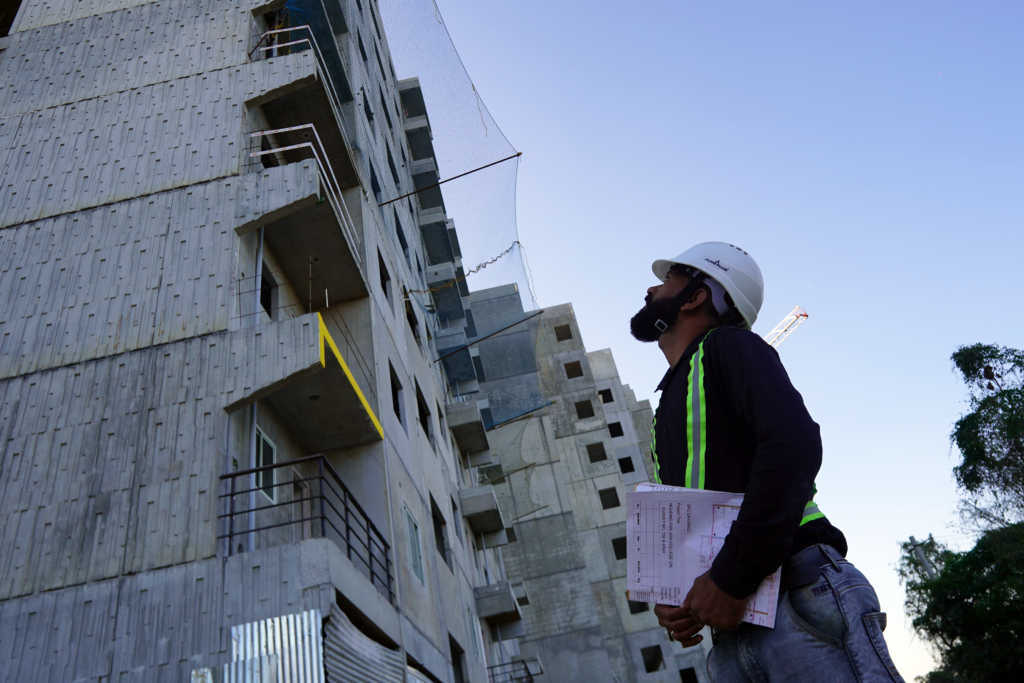
The Pre-cast Revolution in India
Let’s set the scene…
You’re living in one of India’s thriving cities, providing for the people closest to you, and as you look to secure a brighter future for your family, the idea of stepping onto the housing ladder starts to take root in your mind. It’s a common aspiration, a dream held by many, a vision of greater security, enhanced quality of life, and access to reliable services—all contributing to a more promising tomorrow for your children.
Seems straightforward, doesn’t it?
But here’s the startling reality: India is grappling with a staggering shortfall of 25 million affordable housing units. Yes, you read that correctly. 25 million affordable homes are needed.
And with over 40% of the population projected to live in urban areas by 2030, the demand for affordable homes is continuing to skyrocket, and the supply is nowhere to be seen. To make matters worse the built environment is a leading contributor towards total greenhouse gas emissions (and that’s without the extra 25 million houses being added to the equation).
But before you reach for the panic button, have you heard of Janaadhar?
Janaadhar – an affordable housing and innovative technology construction company and partner of Reall – is a pioneering force specialising in precast housing, a groundbreaking method of green, affordable construction.


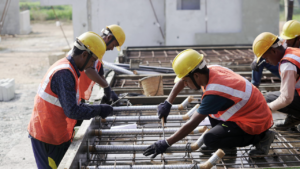
Notice the man in the middle with the grey shirt? That’s Sandeep Bedi. Janaadhar’s CEO and self-diagnosed affordable housing zealot.
He said: “I’m hugely driven by creating an organisation that has the purpose of creating smiles for people who are hopeless because they don’t believe they will be able to own a good quality home in a community in urban India.”
“That’s the purpose that drives us, that excites us.”
Precast moves 90% of the construction process into a factory setting, where structural components are created in bulk before the building is pieced together on site.
“Precast brings manufacturing efficiencies into construction,” Bedi said.
“It controls wastage. It controls pollution. It also reduces raw material consumption and gives you a better-quality product. “We believe that is the only way to create high quality, sustainable buildings, on cost and at scale. Innovation and sustainability are always at the core of everything we do.”
Bedi is right. Because majority of real estate developers and mortgage providers focus on India’s upper and middle class – as they tend to do everywhere – conventional housing remains too expensive for many of the people who need homes. They’re instead forced to rent or buy property in informal settlements, which is often bad quality and ineligible for mortgage loans. Professional people like teachers, nurses, factory workers and successful micro-entrepreneurs like market stall holders block the housing chain for those below them because they can’t move up.
Low-income earners are often forced to live in overcrowded and unsanitary informal settlements. These areas present accessibility problems, with unpaved and narrow paths, lack of lighting and poor sanitation with inadequate water and open sewers. Living in such conditions is a security risk in itself.
Precast housing, on the other hand, is built to the highest grade on planned and serviced sites. It is accessible to those previously excluded from housing finance products – “standard housing, without the frills,” as Bedi puts it.
The stark contrast between these informal settlements and precast housing is a reminder that innovative solutions like Janaadhar’s approach can alleviate the housing crisis faced by many low-income individuals and families in India. By providing affordable, well-constructed housing options, we can begin to address the challenges posed by informal settlements and create a brighter future for those who have long been marginalized in the housing market.
But the precast dream doesn’t end with lifting people out of poverty. The precast technique has a soft spot for the planet too.
Precast buildings have 20% less embodied energy and use 30% less water compared to traditional onsite construction, reducing the carbon cost of construction.
The design ensures resilience is locked in, providing protection against future climate shocks for vulnerable people, in vulnerable areas. To put it simply, pre-cast homes are built for survival. They can endure years without needing repair (Bedi says over 75 to be exact) and can withstand the escalation of extreme weather.
Precast enables efficient and quality construction: better build quality, fewer resources squandered, protection against poor weather or labour shortages during construction. All this increases design efficiencies, limits carbon emissions, minimises delivery time and reduces maintenance costs for homeowners.
With support from Reall, Janaadhar completed the construction of its first factory in December 2021. Their InstaBuild Precast Factory in Bengaluru has the capacity to produce enough components to build up to 800 affordable houses per year.
Asking yourself how Janadhaar has managed to be so successful? It was built with kindness and collaboration at its core (enter Ramesh Ramanathan and Swati Ramanathan).
The high-flying couple were founders of India’s most successful microfinance provider, Janalakshmi Financial Services (now known as Jana Small Finance Bank), but during their careers kept hearing that many of their customers struggled to buy good quality homes. Affordable housing became their target. They wanted to find a way to help, but they needed someone to make their vision concrete (pun intended) and that was when they met Sandeep Bedi and decided to create Janaadhar, together.
Ramanathan says. “The supply of affordable housing is not an easy problem. You need to solve construction quality. You need to solve it at a price point that makes sense. And you need to solve it in today’s world in an environmentally sustainable way. I think we at Janaadhar have managed to navigate that.”
The current build project is a student residence at the Jain University at Kanakapura Road, nearby in Bengaluru, which will become home for up to 1000 students. This project will also include an innovative zero-energy sewage treatment plant or ecostp.

Seeing the unseen, the value of water
An ecostp (ecological sewage treatment process) is a state-of-the-art sewage treatment plant based on a cow’s stomach. Dirty water passes through four sealed chambers in eachplant and is ‘processed’ naturally. It needs no external power, chemicals, or human interaction – only gravity – yet achieves reliable and eco-friendly sewage treatment that will produce clean water for the development’s flushing toilets. Not only that, but the treatment plant produces zero smell and noise pollution, allowing it to reside peacefully under a children’s playground.
The Kanakapura Road Housing project will initially provide 306 student residences that will later be planned to sell as affordable houses. Building is now complete, and students will be residing in these units in the coming months.
Janaadhar were keen to include effective, green, low maintenance wastewater treatment that goes beyond municipal regulations which often expect little more than simply pouring wastewater into a hole in the ground.
When they looked at the mainstream options for sewage treatment plants (STPs), all Janaadhar found were hurdles. Centralised sanitation systems are either overburdened,
don’t work or don’t exist. In a decentralised system, there is an assumption that it must be mechanised, but mechanical STPs are costly to build and maintain, and many communities simply stop switching them on because of high running costs. And even when run correctly, mechanical STPs are noisy, dirty and not climate friendly.
Janaadhar began to look for alternative solutions and after scouring the world, found one right beside them in Bengaluru. ECOSTP (yes, the company has the same name as the innovative technique) have developed an environmentally friendly sewage treatment plant model that uses biomimicry – the idea of copying nature to solve human problems. ECOSTP had been providing systems based on a natural anaerobic digester model in Bengaluru for several years.
An ecostp is low-cost, sustainable, reliable and can work at scale; it’s noiseless and odourless; it enables water to be re-used in places where water is scarce, and even has the potential to allow cleaned water to be sold at a profit.
Janaadhar is now planning to standardise the same green low-cost decentralised sewage treatment plants across all their projects. It’s a fantastic example of local collaboration and will be a demonstration project to government or other organisations in the region and a solution that could also be introduced to other regions, countries or continents.
And Janaadhar’s plans keep getting bigger. To accompany the existing factory near Bengaluru, Janaadhar plan to construct another in Ahmedabad (Gujarat), in India’s western corner. This will help the Janaadhar team to reach their current aim: the construction of 2,000 new homes every year.
But is that enough?
Ramanathan believes that they could produce as many as 10,000, but even with 10,000 new homes every year, Janaadhar’s contribution would be only a drop in the ocean.
“India would need 100 Janaadhars to begin to solve this problem,” he says.
Ramanathan believes the most important ingredient now is sensible, informed financial investment. “This is the role that Reall played for Janaadhar,” he says. “Reall understands its impact on the lives of the people who can actually access this. It understands the impact on society. If it wasn’t for Reall, we would not be where we are today.”
He is confident that, with the required investment, and under the guidance of a pioneer like Sandeep Bedi, Janaadhar will inspire a wider recognition of precast housing’s benefits. It will become a ‘lighthouse’ for other entrepreneurs in his own country, and other parts of the world.
“India is ripe for this,” he says. “And when I say India, I can certainly say that it’s also true of Pakistan. It’s true of South Asia. It’s true of Africa.”
Innovate like Janadhaar and join a green homes revolution today.